During our six weeks adventure we met many fascinating people and experienced some amazing situations. Hope you enjoy the following pictorial summary.
We travelled in an anticlockwise direction, commencing in Joburg (3 days) and progressed through Botswana (16 days), Zimbabwe (overnight), Namibia (16 days) and finally Cape Town (5 days). Very safe and highly recommended! Total approx 7000kms

SOUTH AFRICA
Johannesburg – loved the ladies’ intricate and creative hair braiding; stayed with very friendly AirBNB hosts Georgie and Richard in Bryanston and invited our Uber driver Jabu to join us in visiting the Cradle of Humankind Centre which was fascinating and very informative in regard to the ancestry and development of homo sapiens.
Apartheid Museum – a very disturbing era in South African history. Thank god for Nelson Mandela. What an amazing man.
BOTSWANA – via Smartwater, Maope, Francistown, Nata, Gweta, Maun, Okavango Delta, Moremi Reserve, Chobe NP, Kasane and on the final leg of our trip, Ghanzi, Kuke, Central Kalahari Game Reserve, Rakops, Khama Rhino Sanctuary and Palapye.

Moremi Gorge was delightful and we enjoyed a guided tour in the very peaceful and pristine natural environment.
Throughout Botswana and Namibia, it was the norm to have parking security in towns/supermarkets and fuel attendants at servos. Small tip required for their service.
Guided overnight tour of the Ntwetwe saltpan using quad bikes. Very dusty!! Stopped to see meerkat colony which was excellent. Highlight! Had BBQ dinner prepared by guides and drivers, Vasco and Robert. Slept in bed roll with all clothes on. Cold night but great.
Local donkey wagon transport and the children’s African “salute”
Okavango Delta – overnight guided tour via mokoro (originally dugout canoe – nowadays, fibreglass). Mokoro ride was delightful with Scar our poler. Excellent dinner prepared by Botenga with G & Ts and red wine. Good sleep in tent and bed roll. We included John, Jonas and the elderly gentleman in our evening.
Bundles of firewood were available for purchase on Botswana roadsides. Lots of locals walk, walk and walk to get where they need to go. Can’t afford a set of wheels. Those with a vehicle often offer rides to those who need a lift.
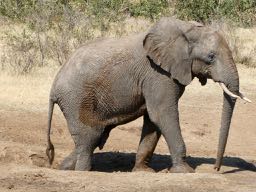
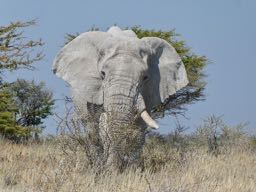
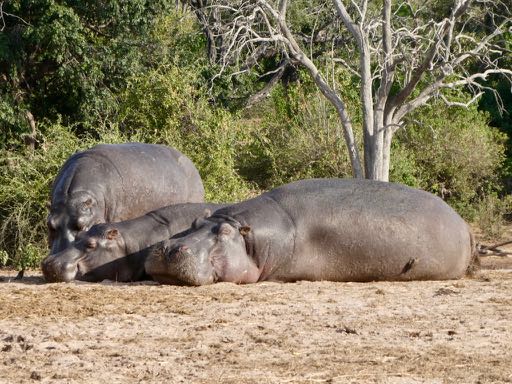
Moremi Reserve – stayed at Khwai Lodge with afternoon game drive at 3.30pm. Excellent! Saw elephants, hippos, antelopes, leopard and warthog. Then a chilly, early 7.00am game drive with Jeremy during which we saw a snoozy hyena. Lodge provided lovely, warm ponchos.

Early morning – chilly!!

Looking after the safari guests
The Avis hired Ford Ranger camper served us well once we became accustomed to its nuances. Met friendly couple Susanne and Hans from Berlin in the Savuti area and Hans just had the right bag of tools to repair our faulty inverter. Thank you Hans!!!
Savuti – the Bushmen paintings at Gobabis were situated on the eastern face of Bushman Hill. The paintings, not carbon dated, are thought to be between 3000 to 4000 years old. They depict various animals of present and past Savuti vintage. Eland, elephant, sable, giraffe, a puffadder and a hippo from wetter times feature on the same panel. A mixture of plant juices, and animal fat coloured with the rusty ironoxide from the rocks was used to create this incredibly durable paint but its exact composition is unknown. There are 22 known sites of paintings around Savuti, most being very faint due to exposure to the elements.

We needed to check a river before crossing to make sure we didn’t drown the vehicle. Rob was the lucky one. Somebody had to keep an eye out for wild animals!!!

Beautiful sunset cruise on the mighty Zambezi River with a glorious African sunset. A cruiseboat full of international visitors with delicious dinner served.

ZIMBABWE – overnight stay at the delightful Batonka Lodge. Visited the absolutely stunning Victoria Falls. We were provided with raincoats which were certainly needed! Helicopter flight gave a wonderful overview of the impressive falls and the incredibly wide Zambezi River. David Livingstone, the Scottish missionary and explorer, is believed to have been the first European to view Victoria Falls on 16 November 1855, from what is now known as Livingstone Island, one of two land masses in the middle of the river, immediately upstream from the falls near the Zambian shore. Livingstone named his discovery in honour of Queen Victoria of Britain but the indigenous name, Mosi-oa-Tunya—”The Smoke That Thunders”—continues in common usage as well. The World heritage List officially recognizes both names. Livingstone also cites an older name, Seongo or Chongwe, which means “The Place of the Rainbow” as a result of the constant spray.
BOTSWANA
Chobe NP – at 3.00pm we set out on a Pangolin Chobe River Safari Cruise with very large Canon cameras to use. Eight participants quickly learnt to manage the 600 ml zoom lens. Fabulous photos from the water of hippos, grazing elephants, water buffalo, crocodiles, various water birds and antelopes. Stunning photographic opportunities. I have never taken so many photos in three hours. We received the memory card at the end of the cruise. My sorting of those photos will take me a few hours I think!!!


NAMIBIA

Caprivi Strip area – stayed at the most relaxing River Dance Lodge; chatted to locals at a traditional village; fuelled up with the assistance of a fuel attendant and enjoyed the giggles of a group of women returning from Sunday church.
Etosha NP
Namutoni – the Herero tribespeople named this place Omutjamatinda, which means “the strong water coming from a raised place” and it was this water that led to the settlement of Namutoni.
In 1851, the first Europeans to come across Etosha, John Andersson and Francis Galton camped at the site of Namutoni and in 1870 a group of Thirstland Trekkers also stopped over. During the rinderpest epidemic of 1897, Namutoni was one of the control posts in the fight to bring this scourge under control. Later, it became a frontier post for trade with Owamboland.
During 1902 and 1903 the German Schutztruppe built the fort at Namutoni, only to have it destroyed by the Owambos in 1904. When Adolph Fischer, of Fischer’s Pan took over the garrison in 1906, a larger fort was built in its place. Fischer eventually went on to become a warden of Etosha National Park and Namutoni was pressed into service as a police post and later as a South African army base.
In 1950, the fort was declared a national monument and seven years later the camp was opened to tourists. We journeyed on to the Halai Campsite and Moringa Waterhole. The word “Halali” is a German word derive from a bugle call to signify that the hunt was over and that the quarry had been bagged. In Etosha, this word signifies that the hunt is over for good and that it is time for conservation. In keeping with this theme, staff used to blow a bugle at Halali to warn tourists that it was nearly closing time for the gate.
Olifantrus Campsite – as explained by several placards placed in the information centre, 525 elephants were culled in two seasons during 1983 and 1985. The Olifantsrus Field Abattoir, the framework of which remains today, was constructed specifically for the purpose of processing their carcasses. The decision to harvest 525 elephants was made in light of the 3 000 strong elephant population present in the park at the time which conservationists believed was not sustainable for the park.
A placard in the Olifantsrus camp stated that “Culling of elephants is a controversial and highly emotive issue. The severe drought between 1980 and 1983 led to the die-off of grass cover at Etosha but at the same time an increase in the population of elephants due to immigration. In 1983, a decision to remove a percentage of the elephant population was based on the perception that their numbers would accelerate desertification and threaten the survival of other species, including the endangered black rhino”.
The complex and carefully planned culling operation was executed to ensure that the endeavour was carried out according to strict, ethical standards in order to limit disturbance and trauma and that the carcasses were optimally utilised thereby obtaining the ultimate value from an elephant. The operation allowed Etosha staff scientists to collect scientific data which directly led to a better understanding of aspects such as calving intervals and seasonal fertility in Etosha’s elephants. The data eventually led to an overall better understanding of elephant populations.
Several new developments in conservation practices – such as providing rural communities with incentives to live alongside wild animals, the ban on ivory trade and new wildlife management practices meant that thankfully, the culling operation was not repeated after the first two times.
Opuwo – was approached in the supermarket by a local, impoverished Himba woman whose parents had died. She had one child and was very hungry. I bought her maizeflour, chicken pieces, tomato sauce and washing powder as requested. She was extremely happy.

Outside, many Himba women were selling bracelets. They descended on me and I bought a bracelet. Eventually the supermarket guard had to move them on. They were very persistent. Lots of full on poverty. Very hard to see.

The Herero women in Opuwo looked amazing with their semi Victorian clothing and horn shaped head dress. Influence from German missionaries.

Opuwo – Himba village visit with guide. Absolutely fascinating – a real trip highlight!
1. How the Himba came to be
The first settlements of the Himba people can be traced back to the early 16th century when they crossed the Angolan border and chose Kaokoland (nowadays called Kunene Region) as their new homeland. At that time the word Himba did not exist because of the fact that they had not yet separated themselves from the Herero tribe.
At the end of the 19th century Namibia was plagued by a relentless bovine epidemic. Most of the cattle that the Herero depended on perished and the tribe faced a great crisis. Subsequently, the tribe moved south and started to explore different regions in order to enhance their chances of survival. Still, some members decided to stay and rather struggle for survival in familiar territories. Then and there the schism between the two tribes became a reality and the Himba identity came into being.
Freely translated from the Otjiherero language, the word Himba means beggar. Why did they inherit this rather derogatory name? Well, after the schism, many of those that remained roamed the vast Kaokoland in search of cattle and crops asking fellow or other tribe members for help.
2. Red ochre
The red ochre cream that the Himba are famous for is made by pounding the ochre stone (Hematite) into small pieces. Thereafter the fragments are mixed with butter, slightly heated by means of smoke and applied on the skin. After many conversations with the elders of the tribe I have come to the conclusion that the main reason for the red ochre is to establish a difference between men and women. Moreover, the red layer seems to help against the scorching sun radiation, while keeping the skin clean and moist and to some extent it blocks hair growth on the body.
On top of the women’s head in the photo you find the Himba crown: the Erembe. This crown is made of cow or goat leather and is placed on the head when a girl reaches puberty. The red ochre, however, is applied when the girls are old enough to look after themselves hygienically. The tribe’s men do not apply red ochre on their skin.
3. Porridge all the way
The Himba people stick to porridge. Every morning and evening they heat some water, wait until it boils, and put some flour in it, maybe add some oil and food is served. The flour is mostly from maize but from time to time you might find some mahangu flour as well. Mahangu is another name for pearl millet, it is a very popular crop in Namibia since it performs well in soils with low fertility. On rare occasions, such as weddings, the Himba do eat meat but this is more an exception than a rule.

4. Holy fire/Supreme being (Mukuru)
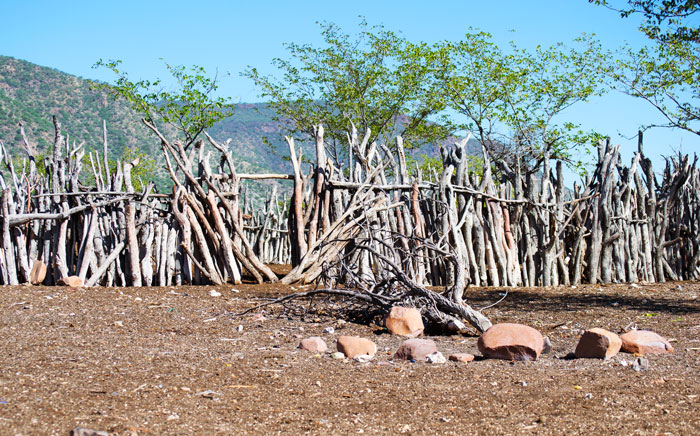
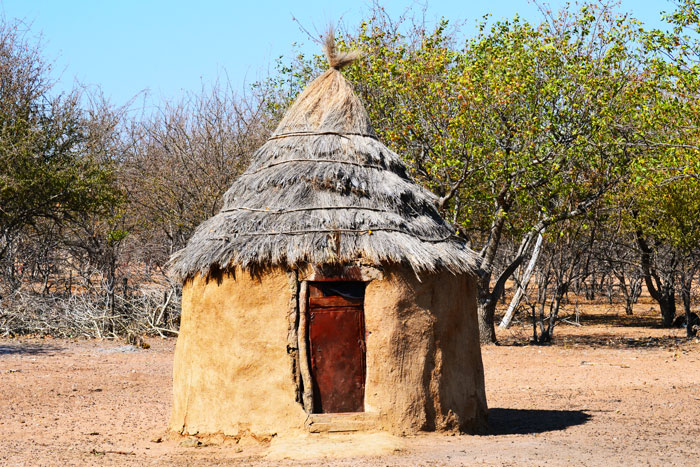
Himbas are animists and their supreme being is called Mukuru. The way they communicate with their God is through the holy fire. The smoke of the holy fire rises towards the heaven which enables them to communicate with their ancestors who stand in direct contact with the Supreme Being. In every village you will find the holy fire smouldering while next to it some logs of wood are put on a sacred stone in order to feed the fire when needed. You are not allowed to cross the holy line if you are an outsider or you have not been invited into the village. The holy line starts from the main entrance of the chief’s hut and goes straight, passing the holy fire, to the entrance of the cattle enclosure.


5. Bathing in smoke
One of the most remarkable Himba traits is that the women are not allowed to use water for washing. This implies themselves and also their clothes. Again, according to the elderly this dates back to the great droughts where water was scarce and only men were allowed access to water for washing purposes. Apart from applying red ochre on their skin, Himba women do take a daily smoke bath in order to maintain personal hygiene. They will put some smouldering charcoal into a little bowl of herbs (mostly leaves and little branches of Commiphora trees) and wait for the smoke to ascend. Thereafter, they will bow over the smoking bowl and due to the heat they will start perspiring. For a full body wash they cover themselves with a blanket so that the smoke gets trapped underneath the fabric.

En route to Etaambura thatch chalet A very hard driving day! Left camp at 8.30am and arrived at Etaambura Camp at 8.00pm. What a challenging day!! Lost the sandy track at one stage and spent an hour trying to get back on the correct route. Then ended up undertaking an extremely tricky rocky mountain pass, the notorious Van Zyl Pass, during which we had to stop three times to carefully get the car down the treacherous track. We were not happy with our tour agent’s limited directions for today’s drive. Very tiring and demanding. Well done Rob for keeping us safe!


NW Namibia was stunning!!!! Stark, grand, remote wilderness, inhabited by the Himba tribespeople. Incredible ancient mountain landscapes, vast expanses of sandy savannah, some rare mountain zebra, cattle, goats and of course, the neverending dust. We saw locals collecting water in 20 litre containers, some even balancing them on their head. I could barely lift 20 litres let alone balance it on my head!!
Khowarib Community Rest Camp – here we met the delightful camp host Josephine and her very cute adopted daughter, Passion. The staple diet in all local places, as we drove through Botswana and Namibia, was only maize flour porridge and meat for breakfast, lunch and dinner. Pretty basic!! In this village of Khowarib there were no veges available. The nearest town was Opuwo which was 139kms away. Josephine was telling us last night that she must pay $30AUD return on the bus plus $5AUD carrying charge for any food she buys. Pretty tough when wages are so small!!
We donated our fruit and veges, Luci solar light and some cash to Josephine and her children. It was a small gesture but we felt compelled to give something to her. Such sad stories!! We are so fortunate in Aus with our generally comfortable lifestyles. Africa is a real eye opener as to how many people are in need.
Addresses were exchanged and we will keep in touch with her. She has three children of her own plus her sister’s delightful daughter, Passion, as her sister had an accident and died. We felt for Josephine who was a lovely person and made us so welcome at Khowarib Community Camp.
As we drove through the village we couldn’t help but feel a sense of desolation. Men sitting around with no work, dilapidated mud huts and a real sense of hopelessness in the dust and sand. We were glad to have contributed in some small way to help Josephine and her family.
Headed towards Mowani area which was in Damaraland where we enjoyed a guided tour of the Petrified Forest area. 280 million years ago, the theory goes, large conifers washed down into Namibia from central Africa and over the millenia, turned into stone. They were discovered by locals in the 1940s. Large trees, lying on the ground, hard as rock. Holes where the branches had dislodged. You could still see the inner tree rings. Incredible!!


We loved the guided tour of the Damara Living Museum, with young Damaraland people showing what life was like for their tribal forebears. Dancing and singing, making crafts, fashioning metal into tools, using medicinal plants, creating fire using sticks (nifty!!), applying ochre only onto faces unlike the Himba women who apply full body ochre. It was an excellent experience.
Mowani Campsite was really good. Set in amongst boulder style hills with small hyrax perched in the rock crevices. They are like large guinea pigs but in fact, related to elephants and dugongs. Fabulous ablution block for each campsite, made with pueblo style mud walls. Rob created an excellent fire and we enjoyed a tasty chicken dinner with red wine. Good sleeping following an excellent day.
Couldn’t believe seeing a lone cyclist undertaking the gruelling, stony, dusty road in Namibia. Hard slog!!!

Swakopmund (west coast of Namibia) – to the untrained eye the dunes of the Namib Desert between Walvis Bay and Swakopmund appear impressive but somewhat lifeless. We were surprised though how diverse and rich in species this eco-system actually was, given the chance to view the desert through the eyes of a real Namibian desert expert: Douglas of Living Desert Adventures, energetic environmentalist and nature conservationist.
This morning we saw four of the Namibian ‘Little Five’ – gecko, chameleon, lizard and white lady spider. Missing was the side winder snake. The easterly winds became quite ferocious, flinging the sand at us from the many dunes. If the wind is from the west and the ocean, it is cooler and calmer. We had a fascinating trip with a very passionate guide. Amazing colours in the dunes.


Left Swakopmund with a hideous easterly wind blowing very strongly so the sand was blowing off the dunes, right onto the toad. It was a maelstrom!!! Unreal. Felt sorry for the locals who were out walking amongst it. Even saw five guys shovelling sand into a ditch as the wind blew it straight back in. Crazy!! Really hard to see other traffic on the road.
NamibRand Hideout Camp – early morning walk for sunrise which was excellent for photography with stunning orange dunes. Andrew our guide was very well informed about the animal tracks, scat (I now know the difference between oryx and zebra poo!) and the hyper arid environment of the Namib Desert. Only 0-100 mm rainfall pa. Still very windy which is certainly not camera friendly. The sand literally flows off the top of the dunes and rains down on you. Camera ended up dying!!
One small beetle (tok tokkie) crawled diligently up the dunes, crested into the strong wind, advanced for a short distance into the sand blast and then promptly turned around and went back down the leeward side of the dune. We applauded its efforts. Loved the centuries old camelthorn trees so duly hugged one.

Drove 65kms on wonderful tar road out to the main dune area of Sossusvlei. Amazingly huge dunes of approx 200m height, one after the other. So much sand piled up!!! Slightly different shades of orange, pink, mauve, crimson and taupe. Big Daddy is the tallest dune of all, at 327m. Rob decided he wanted to climb it. We walked out to the Deadvlei pan which was a surreal vista of stark, dead trees located on a glittering white salt pan. Second camera clicking madly!! Rob then proceeded on his Big Daddy dune trek which took him a good 90 mins to complete. Views up the top were fantastic but he certainly worked hard to achieve them. Shirt off and red face by the time he returned to the car.
Windhoek – we had an interesting meal at Nyamas, a local meat place where the house special was a variety of sauces and side dishes along with a selection of meats on large skewers, brought to the table and then sliced. Following the usual selection of pork, beef and lamb came the zebra and hartebeest. I did try both but they were fairly tough and gamey. Rob’s previous springbok in Swakopmund was much more tender. Interesting!!

BOTSWANA
Central Kalahari Game Reserve – Camera #2 has now died with focus error, no doubt due to sand and grit issues, so I am now left with the iPhone! Bummer! Africa is a camera killer!! Camped at the Dqae Qare Guest Farm owned by the San bushmen community and enjoyed a morning walk with a San bushman in the bush near our campsite, accompanied by a San woman who translated for us. The bushman language was fascinating with lots of interesting clicks. We tried to emulate but failed miserably!
Our bushman showed us the tracks for gemsbok, kudu, impala as well as explaining the various varieties of poo. He explained the medicinal applications of many roots and leaves and the brandy plant which produces small berries and a resultant alcoholic beverage. We also learnt that the San buried their dead in aardvark holes. Most convenient! We compared our hands and ours looked like giant sized hands compared to the bushman’s small, nut brown hands.
We were impressed by the making of fire using a vertical twirling stick and a horizontal slotted hole stick. After very quick twirling, small amounts of hot sawdust and smoke were produced which were then added to powdered zebra poo and gradually the flames were breathed into life using folded dry grass. Very nifty!! He had the calloused hands to prove that he had created many fires. For craft making, broken ostrich egg shells, which are very tough, were used to create tiny, rounded discs that were drilled and threaded into intricate pieces of jewellery. To obtain a browner colour they were roasted on the fire. Amazing amount of time to create bracelets, necklaces and earrings.
Our guides spoke of children currently being taught the old San life skills but we wondered if this will really succeed given that the government has decreed that the San people are not allowed to hunt game any more and children must attend school. If they want meat they have to purchase it from the shop. Ostrich egg shell must also be purchased. The lodge and campsites were owned and run by the San community but our guides spoke of lack of money and the hardship of living. Because the lodge was located on a private reserve, no goats or cattle can be farmed. Everything they need costs money so it is an ongoing struggle. The village was a distance away and the main staff were needed constantly at the lodge so no chance to go home and see family.
Arriving in Rakops, time to refuel with the help of a very unsmiling fuel attendant. Rob found a nearby air compressor to inflate the tyres in readiness for the tar road taking us back through Botswana, en route to Joburg. A young boy of very few words assisted Rob but he got the job done. On being given a bag of maize flour, he then asked “Money???” Sorry, no money kiddo, just maize today!
SOUTH AFRICA
Crossing the border into South Africa we stayed at Leeuwenhof Lodge which was pure luxury after all our sandy campsites. Flew to Cape Town for our final few days of the trip. Can thoroughly recommend self driving in Botswana and Namibia. Fabulous experience!! Will miss all those amazing animals and the lovely smiling black faces with their beautiful teeth!!!
After a relaxed start, we purchased our Cape Town Hop on, Hop off bus package and climbed aboard. Table Mountain was spectacular!!! Fabulous views, cable car engineering was amazing, scenery was unbelievable. We spent two hours just enjoying the whole area. Loved the Kirstenbosch National Botanical Garden which is acclaimed as one of the great botanic gardens of the world. Few gardens can match the sheer grandeur of the setting of Kirstenbosch, against the eastern slopes of Cape Town’s Table Mountain. A very relaxing place with a real tranquility. Great morning tea as well!
A fascinating guided walking tour of Cape Town shanty township, Imizamo Yethu ,which was established in the early 1990’s, as an area where mainly black people were allowed by the authorities to build homes known as ‘shacks’ or temporary shelters. Many of the black residents of Hout Bay could not afford, and by law were not allowed, to buy property or homes in Hout Bay and had no choice but to look for vacant land on which their temporary homes were built. This was done in many cases without permission and lead to much unhappiness and aggravation with their white fellow residents.
In 1989 the local government had to intervene and a piece of property was developed with basic services (roads, water and sewerage) on which black residents were allowed to build their temporary shelters and named it: Imizamo Yethu Estate (Imizamo Yethu is Xhosa for ‘our combined effort’) Since its inception Imizamo Yethu has more than doubled in size and it is estimated that approximately 35,000 people reside in Imizamo Yethu in 2018. Many of the temporary shelters of the past are now being replaced by higher quality, solid concrete homes.
Although positive changes have taken place in South Africa since the first democratic elections in 1994, the influx of additional Xhosa, Angolan and other refugees have kept housing needs and unemployment at a critical level. The recent involvement of an Irish businessman, Niall Mellon resulted in more than three hundred brand new, high quality homes of concrete being built in the last seven years with promises of many more. This initiative showed the difference which can be made by getting involved and sharing of one’s talents and resources for the benefit of less privileged people.
The residents of Imizamo Yethu comprise mainly Xhosa speaking people, originating from the Transkei in the Eastern Cape where many still have family members living. Transkei is also the birth place of the past president of South Africa, the legendary Mr. Nelson Mandela. In the early years many residents of Imizamo Yethu were those without educational or skills training opportunities which resulted in much suffering and hardship.
Imizamo Yethu has a unique ‘vibe’ and vibrancy which is especially noticeable by visitors from outside. A spirit of caring and friendliness (‘ubuntu’ as it is known in Xhosa) are experienced everywhere with children playing peacefully outside their homes and often in the streets. Traders selling their goods ensure that many essential items can be purchased within a stone’s throw distance from most homes. Many convenience shops (Spasas) are located in and around homes where residents can buy their bread, milk, basic groceries and of course, sweets and cold drinks for the ever hungry children. Imizamo Yethu is a haven for entrepreneurs who are willing to try just about anything out to do business and make a small profit.
Progress and development often also have their negative effects on a society and Imizamo Yethu’s residents are also not spared in this regard. Many homes have problems with alcohol and drug abuse, woman and child abuse and crime.
Imizamo Yethu is in an exciting transformation phase where it is rapidly moving away from its dreaded ‘informal settlement’ status to a fully fledged, proud suburb of Hout Bay. The future is a lot brighter for the residents of Imizamo Yethu who have struggled and work tirelessly for many years towards a place they could be proud of and enjoy living in. Much hard work is still lying ahead for them but a process has started which can not be reversed and hopefully one day the children of Imizamo Yethu will be able to look back with pride at what has been achieved by their parents and community leaders.
Shared a fun evening with our wonderful Cape Town AirBNB hosts, Dennis and Amanda and their friends. On the following morning we enjoyed a bus tour south of Cape Town to explore the scenic Cape of Good Hope. Stopped to enjoy colony of small South African penguins along the way at Boulders. Great to see them roaming freely in their natural environment.
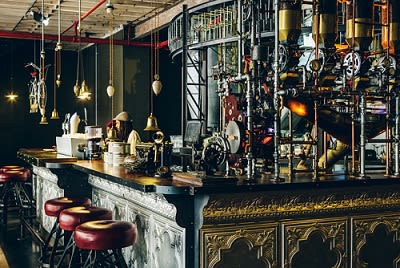
Sadly, our final touring day in Cape Town. Rob met delightful Cape Townians Dirk and Martie in a Namibian river near Khowarib – as you do! They offered to show us around which was very generous. We loved Truth Cafe, a fascinating place. This “steam punk” themed cafe reminded me of a Victorian industrial establishment but does so with a well decorated flare. Coming from the world’s oldest coffee capital, Truth Coffee Roasting has specialised in selecting and roasting the world’s most exclusive coffees. Voted the world’s best coffee shop by the Daily Telegraph for a second year in a row. I have just written an email to the company recommending they set up a cafe in Melbourne. It would be so different!


Then on to wineries, Spice Route and Fairview. Great food, cheeses and wines. Lovely way to send our final day. Feels like we have been away from Aus for months. A great adventure! We highly recommend visiting Southern Africa. A fascinating place with so many amazing possibilities. Please contact us if you would like more details on our trip.


Farewell Africa – we had a fabulous trip. Love to see more of you in the future!!


















 Travel Adventures