
On arrival in Jordan my room mate and I were not disappointed. Clean airport, clean roads, vehicles that stayed in their lanes and no incessant beeping of car horns. We were met and transferred to our Amman hotel, where our Jordanian Group Leader was waiting for us. There were also new group members joining the trip in Jordan and we ended up with 12 participants of mixed nationalities. Welcome to Jordan, cosmopolitan and contemporary, yet steeped in biblical history. There was a group meeting to discuss the next seven day stage of our itinerary.

The Amman streets were tidy with plenty of eager shopkeepers ready to haggle. As Middle Eastern cities go, Amman is a relative youth, being mostly a creation of the 20th century. But though it lacks the storied history and thrilling architectural tapestry of other regional capitals, there’s plenty here to encourage you to linger awhile before making for Petra, the Dead Sea or Wadi Rum. In fact, Amman is one of the easiest cities in which to enjoy the Middle East experience.
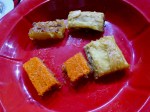
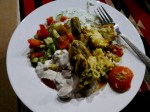
Downtown Amman was a must-see. We enjoyed an exploratory walk around the shops and enjoyed some traditional food – falafel, tabouleh and the traditional very sweet and creamy kanafeh. Shopkeepers were very keen to garner a sale and prices were not as inflated as those in Morocco and Egypt. Bargaining was a little more challenging!!
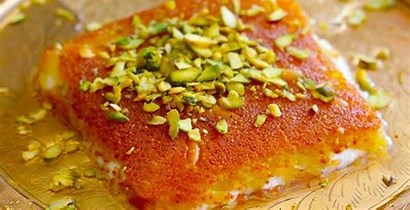
Kanafeh – very rich, sweet and creamy! Total indulgence!!


I was very impressed with the detailed beauty of the shell inlaid work in boxes and furniture. Incredibly detailed craftsmanship.
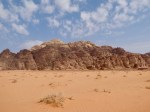
We followed in the footsteps of Lawrence of Arabia with a journey to the extraordinary desert scenery of Wadi Rum, a rugged moonscape of huge sandstone mountains (approximately 5 hours). A 4-hour jeep safari took us through some of the most beautiful and sublime desert scenery on the planet, a true highlight of this trip. Wadi Rum was full of weird and beautiful lunar-like rock formations, and traces of ancient civilisations could be seen in the many carved inscriptions found throughout the area, from pictographs to Thamudic, Nabataean and Arabic texts.


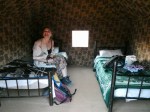
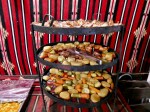
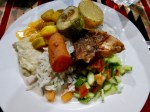
The most enduring monuments in Wadi Rum were those carved by nature – the natural rock bridges, towering rose-coloured sand dunes and scattered rocky peaks. We slept in a simple Bedouin desert camp and enjoyed a delicious dinner cooked in an earthen oven by our Bedouin hosts. The Bedouins have realised that tourism has a lot to offer in terms of financial rewards and there are 150 such desert camps runs by various tribal families throughout Wadi Rum. It was a very pleasant set up with dual sleeping tent rooms, a common gathering tent and a dining tent plus bathroom facilities. The two night stay was a very pleasant reprieve from city touring. Food was great too.


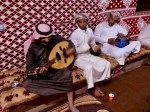
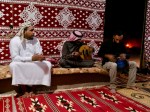
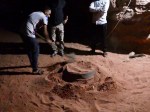
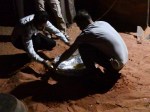

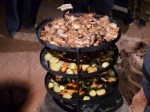
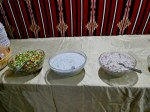

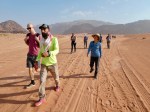

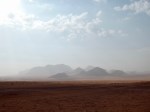


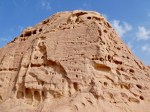
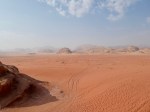
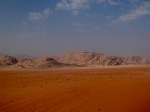
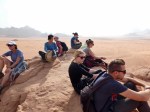

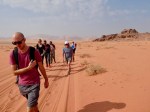

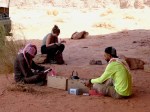


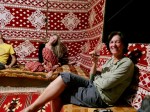

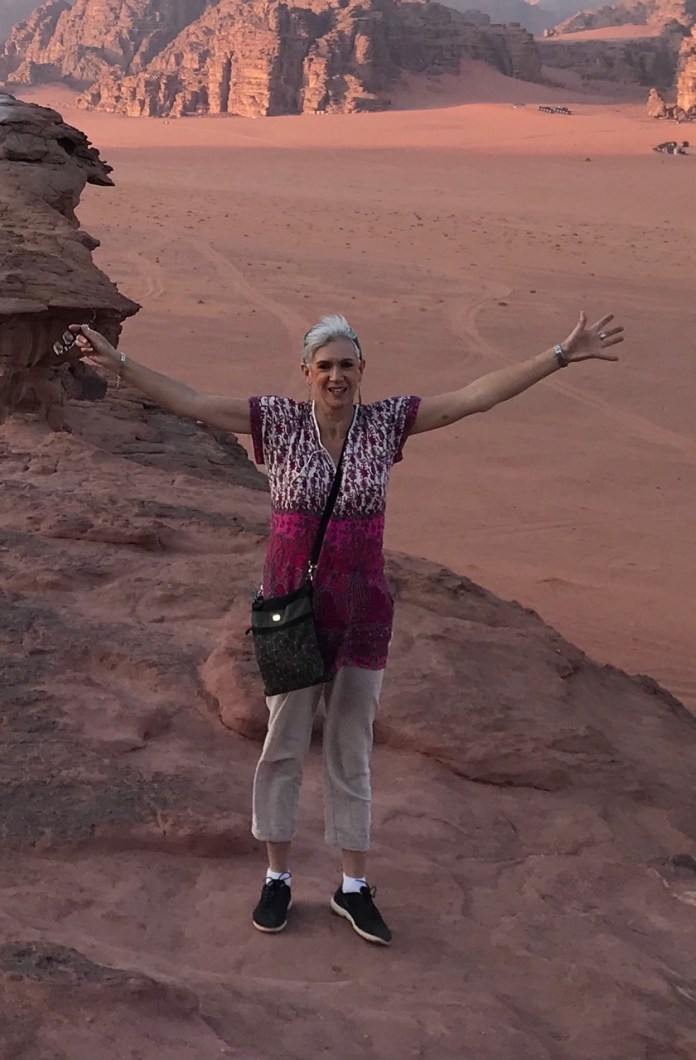
Wadi Rum is probably best known for its connection with the enigmatic British officer T.E. Lawrence, who was based here during the Great Arab Revolt of 1917-18. We spent another memorable night in the desert camp with our new Bedouin friends. Meaning ‘Desert Dwellers’ in Arabic, the Bedouins are a semi-nomadic people, and in Jordan up to 40 per cent of the general population is thought to have Bedouin ancestry. This might explain the legendary hospitality of the Jordanians – in traditional Bedouin culture, a huge onus is placed on taking in and feeding any visitor, and so we enjoyed brilliant hospitality while we were in this incredible place. We survived a 10km trek in the sand and were very happy to return to camp and put our feet up!!!! Felt like 20kms because of the sand.
We continued our journey to the fabled city of Petra (approximately 2 hours) by private minivan. The entrance fee to Petra included a ‘free’ ride on various forms of animal transport and as such we were offered this transport by a number of local Bedouin on the walk into the ancient city. While free to ride, there was a strong expectation that you would need to tip the animals’ owners.
In 2018 the animal rights group PETA (People for the Ethical Treatment of Animals) launched an international campaign highlighting the mistreatment of working animals in the ancient city of Petra. The animals – horses, donkeys and camels – carry both tourists and supplies to the city and through it.
The situation is a complex one – Jordanian organisations and their international partners are trying to improve the conditions for the animals, and for many local Bedouin this activity provides their only income yet issues around animal cruelty are raised on a regular basis. UNESCO themselves have stated that switching to motorised transport is not the preferred option in the ancient city. As a responsible travel company Intrepid believes that – until conditions improve – their travellers should avoid using any form of animal transport in Petra, and if asked at the ancient city we should politely decline which we certainly did.
The site remained unknown to the Western world until 1812, when it was discovered by Johann Ludwig Burckhardt, a Swiss explorer. It was once described as ‘a rose-red city half as old as time’ in a sonnet by John William Burgon and UNESCO has described it as ‘one of the most precious cultural properties of man’s cultural heritage.’ In 1985, Petra was designated a World Heritage site. So we knew we were in for an amazing experience there.
One of the world’s most visually stunning archaeological sites, Petra (meaning ‘the rock’ in Greek) is an abandoned necropolis of temples and tombs cut into towering cliffs of red, pink and orange sandstone. Primarily known as a commercial and ceremonial center of the Nabataean culture during the centuries before and after the time of Christ, the region of Petra was inhabited in far greater antiquity. Archaeological excavations have revealed a rock shelter of the Upper Paleolithic period, dating to around 10,000 BC, and a Neolithic village from the 7th millennium BC. While evidence of habitation during the Chalcolithic and Bronze ages has not yet been found, the region of Petra was again occupied in the early Iron Age, around 1200 BC, by the Edomite culture of the Old Testament (Edom, meaning red, is the Biblical name for this region of the Middle East).


During the 6th –4th centuries BC, the Nabataeans, a nomadic tribe from the northwestern part of Arabia, entered and gradually took over the lands controlled by the Edomites. The first historical mention of the Nabataeans is in a list of the enemies of the King of Assyria in 647 BC, during which time Petra was still occupied by the Edomites. There are several reasons, religious and economic, suggested for the Nabataeans selection of Petra as their capital. The city of Petra is situated at the beginning of Wadi Musa, meaning the Valley of Moses, and this site had long been venerated as one of the traditional sites where Moses struck the ground and the water gushed forth. The region was also revered by the Nabataeans as the sacred precinct of their god Dushara.
Petra’s prominence also derives from its proximity to ancient caravan routes, its easily defended location, stable water resources and proximity to rich agricultural and grazing lands. The Nabataean capital was strategically situated only twenty kilometers from the crossroads of two vital trade routes; one linking the Persian Gulf (and thereby the silks and spices of India and China) with the Mediterranean Sea (and the empires of the Greeks and Romans), the other connecting Syria with the Red Sea. In their early years, the Nabataeans probably only plundered these caravans but as they grew more powerful they seem to have levied tolls as a guarantee of safe conduct. By the third and second centuries BC, the city of Petra had developed into a rich and powerful center of the caravan trade.
We squeezed through a mile-long narrow path, known as the Siq, through huge towers of rock and got our first glimpse of the iconic Treasury – it was impossible not to imagine the armies and traders who made their way down here in the ancient times. It was amazing to think that this awesome, intricate building entrance was hand carved out of the rock. We were suitably impressed.
The Treasury was probably constructed in the 1st century BC. As its design has no precedent in Petra, it is thought that it was carved by Near-Eastern Hellenistic architects. The purpose of the Treasury remains something of a mystery. One thing that is fairly certain, however, is that it was not a treasury. In reality, the Treasury is generally believed to be a temple or a royal tomb, but neither conclusion is certain.
The tomb/temple got its popular name from the Bedouin belief that pirates hid ancient pharoanic treasures in the tholos (giant stone urn) which stands in the centre of the second level. In an attempt to release the treasure, Bedouins periodically fired guns at it — the bullet holes which are still clearly visible on the urn. When the first Western visitors arrived at Petra in the 19th century, a stream ran from Siq and across the plaza. The stream has since been diverted and the plaza leveled for the sake of tourists.
The Treasury’s façade has two levels, decorated with columns, classical rooflines and badly weathered sculptures. Perched atop the façade is an eagle, a Nabataean (and Greek) male deity symbol. The central figure on the upper level tholos may be the fertility goddess of Petra, El-Uzza (associated to the Egyptian goddess Isis). The vertical footholds on either side may have been made to aid the sculptors.
The portal on the bottom level is reached by small flight of steps, and is flanked by mounted figures believed to be Castor and Pollux, sons of Zeus. Inside, a colossal doorway dominates the outer court and leads to an inner chamber of 12 square meters. At the back of the chamber is a sanctuary with an ablution basin (for ritual washing), suggesting that the Treasury was a temple or some other kind of holy place. The chamber can no longer be entered, but it is possible to look in from the doorway.


In 106 AD, the entire Nabataean kingdom came under the control of the Roman Empire. During the ensuing centuries Petra continued to prosper as the Romans carved many buildings as well as a great theatre capable of holding 3000 spectators. While the political and economic power was completely in the hands of the Romans, the Nabataeans continued to adhere to the practices of their own religion. With Emperor Constantine’s proclamation of Christianity as the religion of the Roman Empire in 324 AD, Petra and the lands of the Nabataeans came under the sway of the Byzantine Empire for the next three hundred years. An inscription in the so-called Urn Tomb indicates that the interior was converted to a Christian church in the fifth century.
The Christianization of the Roman Empire signalled the end of the golden era of Nabataean culture and the magnificent city of Petra. Decline slowly set in. With the establishment of the Umayyad Caliphate in Damascus in 661 the region of Petra fell under the control of Islam and the commercial importance of the city plummeted. A series of earthquakes in the 7th and 8th centuries destroyed many of the cities in the region, further weakening the agricultural and commercial infrastructure. Following the establishment of the Abbasid Caliphate in Baghdad in 750, the region of Petra was neglected and thereafter virtually disappears from the historical record. Abandoned to time and the elements, Petra was unknown to the outside world – with the single exception of an insignificant Crusader fortress built in the 12th century – until its ‘rediscovery’ in 1812.

Moving on from Petra, we travelled the King’s Highway to the historic crusader castle of Kerak, which stood on a cliff commandingly overlooking Wadi Karak and the Dead Sea in the distance (approximately 2.5 hours). Kerak Castle is a typical example of Crusader architecture, with Romanesque-style stone vaults, numerous corridors, and strong doorways. The Crusader parts of the ruins are mostly on the upper level and can be identified by their dark volcanic tufa; later Arab additions are in white limestone. Through a massive door, steps lead down to vast, dimly-lit, vaulted rooms and corridors underground.
The upper courtyard includes the remains of a Crusader chapel and provides excellent views over the Jordanian landscape to the Dead Sea. The west wing of the complex is home to the small Kerak Archaeological Museum, which displays artifacts excavated at the site. We had time to explore the evocative ruins and discover the legends of the 12th-century battles between the Crusaders and the Muslim armies led by the Arab hero, Saladin. The small areas of prisoner retention made one realise what it was like to be kept in such small areas for long periods.


Moving on, we drove to the shores of the Dead Sea, the lowest point on Earth (420 metres below sea level). This isn’t actually a sea but a super-salty lake (dead because of the lack of life in it) where the density of the water means participants went for a float, not a swim. With a salinity of 342 g/kg, or 34.2% (in 2011), it is one of the world’s saltiest bodies of water – 9.6 times as salty as the ocean – and has a density of 1.24 kg/litre, which makes swimming similar to floating. This salinity makes for a harsh environment in which plants and animals cannot flourish, hence its name. The Dead Sea has attracted visitors from around the Mediterranean Basin for thousands of years. It was one of the world’s first health resorts (for Herod the Great), and it has been the supplier of a wide variety of products, from asphalt for Egyptian mummification to potash for fertilisers.
The Dead Sea is receding at a swift rate; its surface area today is 605 km2, having been 1,050 km2 in 1930. This sea has shrunk by 30% and scientists say we may only have 50 years to float in these healing waters. The recession of the Dead Sea has begun causing problems, and multiple canals and pipelines proposals exist to reduce its recession. One of these proposals is the Red Sea–Dead Sea Water Conveyance project, carried out by Jordan, which will provide water to neighbouring countries, while the brine will be carried to the Dead Sea to help stabilise its water level. The first phase of the project is scheduled to begin in 2018 and be completed in 2021


We spent some time relaxing here and got some classic floating pictures. The mud here is supposed to have healing properties, and some participants covered themselves from head to toe for a nutrient-rich natural mineral mud bath. I passed!!
We continued to Mt Nebo, the spot where the prophet Moses is said to have seen the ‘promised land’ and where he’s supposedly buried. We explored this sanctuary and viewed the remarkable mosaics of the 4th century church.
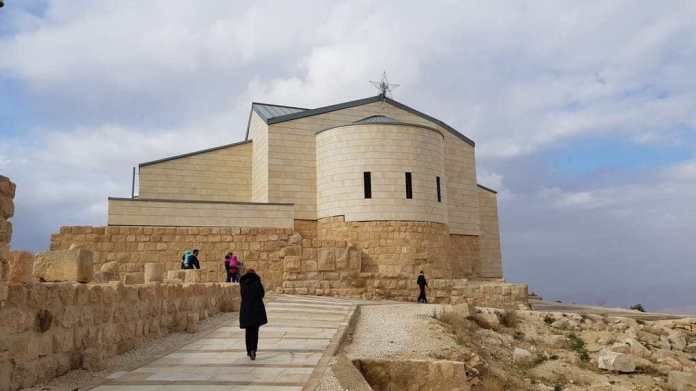


30 minutes down the road was the historical town of Madaba, famous for its Ottoman-style houses and beautiful Byzantine-era mosaics, including the famous 6th-century mosaic map of Jerusalem and the Holy Land at St George’s Church. Other mosaic masterpieces found within churches and the Archaeological Museum depict a rampant profusion of flora and fauna, as well as scenes from mythology and daily life. Literally hundreds of other mosaics from the 5th to 7th centuries are scattered throughout Madaba’s churches and homes.


Then we left Madaba for a short drive north (approximately 75 minutes) to Jerash, once one of the grandest ancient Roman cities in the world. These are some of the best preserved Greco-Roman ruins around. Renowned worldwide for its archaeological treasures, Jerash boasts an as unbroken chain of human occupation dating back more than 6.500 years. The city’s golden age came under Roman rule and the site now generally acknowledged to be one of the best-preserved Roman provincial towns in the world.
It reveals a fine example of the grand formal provincial Roman urbanism that is found throughout the Middle East, comprising paved and colonnaded streets, soaring hilltop temples, handsome theatres, spacious public squares and Plaza baths, fountains and city walls pierced by towers and gates. Beneath its external Greco – Roman veneer, it also preserves a subtle blend of east and west. Its architecture, religions, and languages reflect a process by which two powerful cultures meshed and coexisted, The Greco – Roman world of the Mediterranean basin and the ancient traditions of the Arab Orient.
The city thrived due to its position on the route of the spice and incenses trade, and it reached its zenith as a favourite of the emperor Hadrian around AD 130. The ancient walled town that survives today is a remarkable evocation of life 2,000 years ago. During the Roman period, Jerash was part of the Decapolis, a league of ten cities along the eastern border of the Roman Empire. Its strategic position at the crossroads with the ancient trade route connecting the Mediterranean with the East was a crucial factor to its economic growth.
Until the end of the Umayyad period in the 7th century AD, Jerash remained a lively provincial city. Afterwards, it was struck by the devastating earthquakes of the 6th century AD and lost importance, gradually disappearing under the sand. Abandoned for centuries, it was repopulated only in the 19 century by Circassian, who were forced to resettle from Russia to the Ottoman Empire. It was around this time that the first archaeologists acquired an interest in the area and started exploring its ancient ruins. Their intense work of investigation, conservation, restoration, and reconstruction over the past two centuries, has brought back to light the ancient city remains. Excavations are continuing to these days to restore, and expose new monuments. Meanwhile, Jerash continues attracting every year a greater number of visitors from all nationalities and is now the second-most popular touristic place in Jordan.
During our visit a crane came to a sticky and broken end as it was lifting rubble out of the Temple of Artemis. The driver scrambled out of his cab and was OK. Not so for the actual crane which hit the ground with a very loud crash!!!!


And so my five weeks in Morocco, Egypt and Jordan came to an end. Thankfully Jordan was a more positive experience with Petra and Wadi Rum the standouts. Yazan, our Jordanian tour guide, was very enthusiastic in sharing his knowledge of the country and overall, the weather was very pleasant, averaging 25 degrees C. Throughout the Middle East, the smoking culture is very strong and that was very challenging, especially around food. I found breakfasts to be quite savoury with a major focus on white bread so I became very savvy at locating fresh fruit and yoghurt throughout the trip. As they say, what doesn’t kill you makes you stronger!!! Onwards to Dubai for my final five days.
 Travel Adventures